

From Lab to Clinic: Deploying GWHT Technologies in Kenya
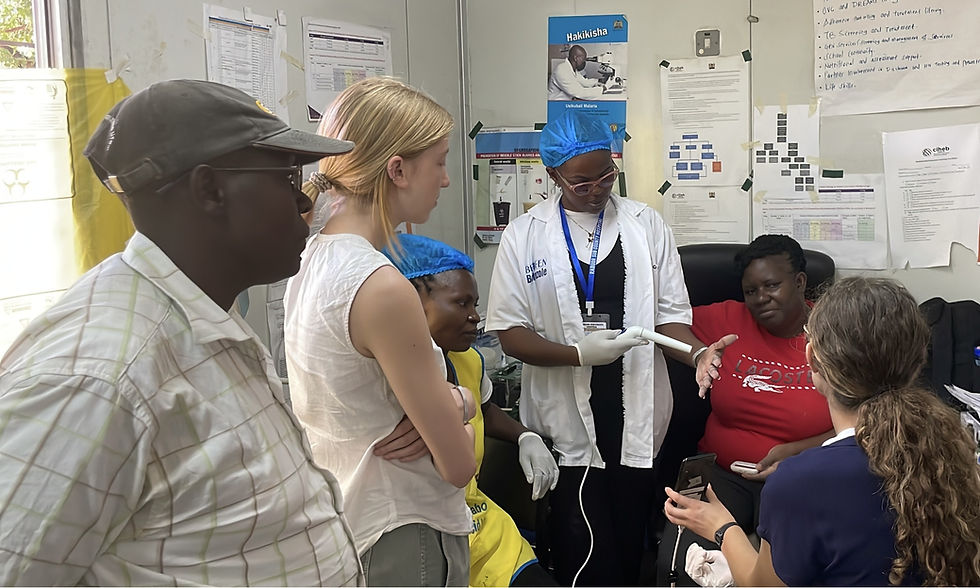
As GWHT advances patient-centered technologies for cervical cancer screening, a central focus is training the people who can carry this work into clinical settings. The Translational Fellows Program, developed and led by Executive Director Marlee Krieger, plays a key role in this effort, connecting research, clinical partnerships, and technology deployment.
In January, post-baccalaureate fellows Rebecca Farrar and Maia Raynor worked alongside Krieger and collaborators at the Kenya Medical Research Institute (KEMRI) in Kisumu, Kenya. There, they supported deployment of the Pocket Colposcope, a portable imaging device designed to improve access to cervical cancer screening in nearby clinics. This work reflects GWHT’s broader approach to deployment, where technologies are tested, adapted, and integrated within real healthcare systems through long-term clinical partnerships.

The experience underscored the need to adapt in real time. In practice, this meant working through challenges on-site with local clinicians, whose expertise shaped adjustments to training and clinical workflows. In busy clinic settings, teams worked with limited resources and unpredictable schedules while continuing to deliver care.
For Rebecca, the visit reshaped how she understood the work being done at Duke: “All of the assumptions that I had made about what was actually going on are just totally out the window.” Maia similarly reflected on the importance of being on site: “We did not fully understand the clinical workflow or the day-to-day challenges. It’s very different to see it firsthand.”
Observing the full screening process made clear how much time, coordination, and effort goes into each patient interaction, something that is not always visible when working only with data. Being in the clinic provided important context for the images collected with the Pocket Colposcope and is helping to inform ongoing work across GWHT, from device design to training and implementation.
Experiences like this are central to the Translational Fellows Program, which prepares trainees to move technologies from the lab into real-world clinical environments.
Following their time at GWHT, Maia will continue her training at Albert Einstein College of Medicine, and Rebecca will begin doctoral studies in biomedical engineering at Duke. Their work reflects the broader goal of the program: to develop engineers and clinicians who can translate innovation into improved access to care.


Comments